TQM and employee morale: why culture drives quality
outcomes
TQM improves employee morale through three mechanisms: participation, ownership, and visible success. Participation: TQM engages employees in identifying problems and designing solutions — people who contribute to improvement feel invested in its success. Ownership: TQM gives employees responsibility for the quality of their own work — rather than relying on inspection to catch their errors, they are empowered to prevent errors and improve the processes they control. Visible success: when a Kaizen event or improvement project produces a measurable result, the team members who contributed experience the satisfaction of visible achievement — a powerful motivator that management bonuses and recognition programs rarely replicate. The morale-quality connection operates in both directions: higher morale produces better quality outcomes, and better quality outcomes — fewer errors, less rework, less firefighting — produce higher morale. TQM creates a self-reinforcing cycle of engagement and improvement.
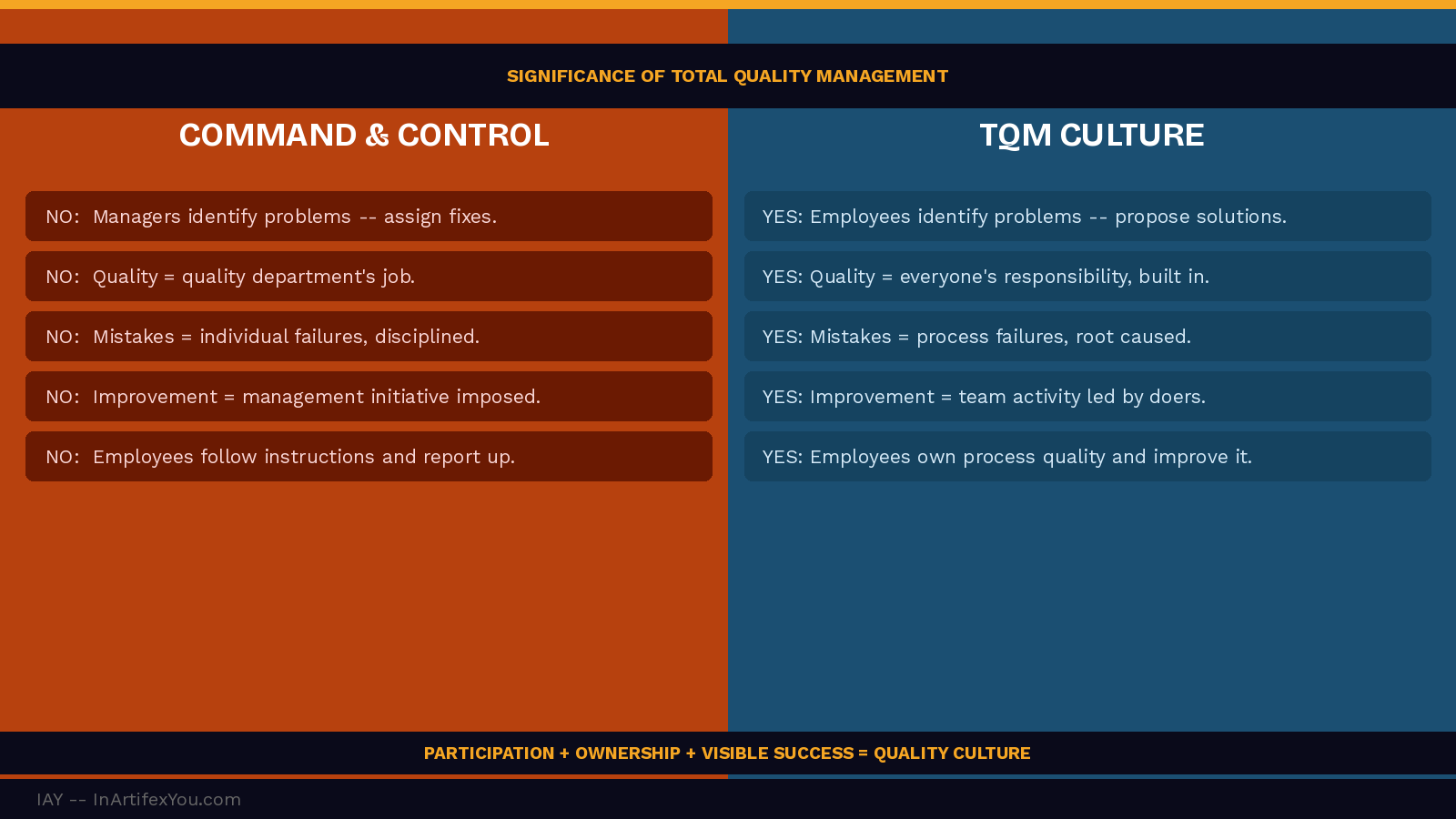
The connection between employee morale and quality performance is not soft or anecdotal — it is measurable. Organizations with high employee engagement consistently outperform low-engagement organizations on quality metrics: lower defect rates, faster problem resolution, higher first-pass yield, and lower COPQ. TQM addresses morale not as a human resources objective but as a quality system design requirement — because a workforce that is disengaged, does not own quality outcomes, and does not participate in improvement will produce quality results that no inspection system can fully compensate for.
Why Conventional Management Approaches Erode Quality Culture
|
COMMAND AND CONTROL Managers identify problems and assign fixes. |
TQM CULTURE Employees identify problems and propose solutions. |
The Three TQM Morale Drivers
Driver 1: Meaningful Participation
TQM creates structured mechanisms for employees to participate in improvement — Kaizen events, quality circles, improvement suggestion systems, and cross-functional teams. Participation in improvement is motivating because it converts employees from passive recipients of management decisions into active agents of change. The employee who redesigns a process step to eliminate a recurring defect has a fundamentally different relationship with quality than the employee who is simply told to do the process differently.
Driver 2: Process Ownership
TQM's principle that quality must be built in — not inspected in — requires employees to take ownership of the quality of their own work. This ownership is motivating when it is genuine: employees who have the tools, training, and authority to control their process quality experience higher engagement than employees who produce work that is then checked by someone else.
- Provide SPC tools at the workstation — employees who can see their own process data in real time take more ownership of process stability.
- Train employees to perform their own first-piece inspection — remove the dependency on a separate quality inspector for routine conformance verification.
- Give employees the authority to stop the process when they detect a quality problem — the andon cord principle from Toyota Production System.
Driver 3: Visible Achievement
SQNothing builds morale like visible results. When a team runs a Kaizen event that reduces defects by 40% in their area, the before-and-after data is concrete evidence that their contribution mattered. TQM organizations that celebrate improvement results visibly — posting before-and-after metrics, recognizing team contributions publicly, sharing financial impact with the teams that created it — build a culture where improvement becomes its own reward.
The Culture-Quality Principle
You cannot inspect your way to a quality culture.
Quality culture is built by giving employees the tools to see their process, the authority to stop it when it produces defects, and the recognition when they improve it. That combination — visibility, authority, and recognition — produces engagement that no training program or incentive scheme can replicate.
Back to hub: Significance of TQM.
| ||||||||||||||||||||||
The Continuous Improvement Certification at InArtifexYou gives you a complete, practical system to map, baseline, improve, and sustain any process — and the verified credential to prove you can lead it.
inartifexyou.com/continuous-improvement-certification-online.html | ||||||||||||||||||||||
|