TQM cost reduction: how to calculate and prove
financial impact
QM reduces costs primarily through four Cost of Poor Quality (COPQ) categories: internal failure costs (scrap, rework, downtime caused by defects caught before delivery), external failure costs (warranty claims, returns, customer complaints, field service caused by defects that reached customers), appraisal costs (inspection, testing, and audit activities required to detect defects), and prevention costs (training, process improvement, and quality system investments that prevent defects from occurring). TQM's cost reduction logic: investing in prevention reduces internal and external failure costs at a ratio typically between 3:1 and 10:1 — every dollar invested in prevention eliminates three to ten dollars of failure cost. To prove the financial impact of TQM, calculate total COPQ before and after improvement — the reduction in failure and appraisal costs minus the increase in prevention investment is the net financial return.
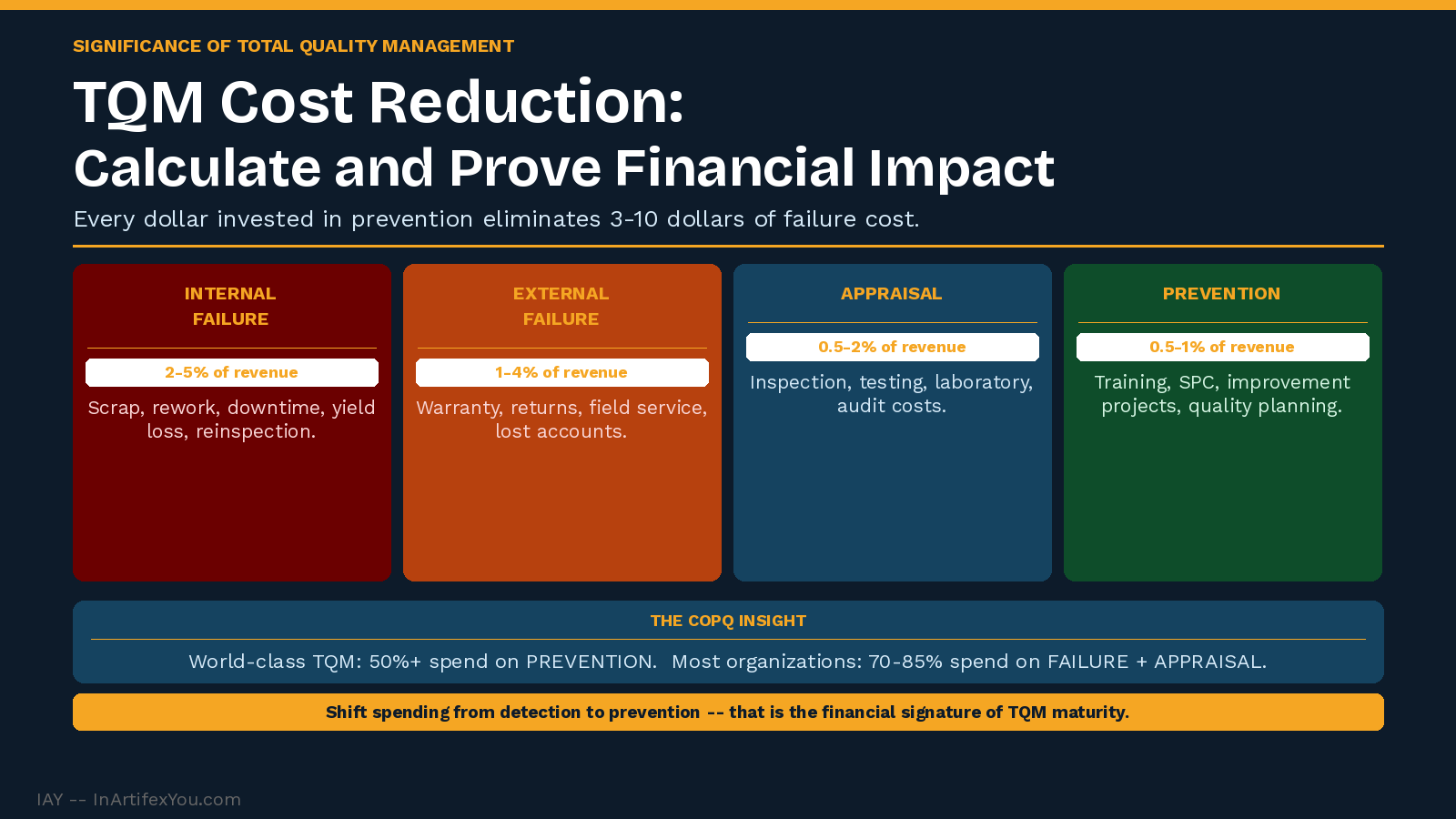
The financial case for TQM is straightforward when COPQ is measured correctly — but most organizations significantly underestimate their COPQ because they only count the costs they can see easily: scrap, rework, and warranty claims. The hidden COPQ — expediting costs, lost customer lifetime value, management time spent firefighting quality problems, and the opportunity cost of capacity consumed by rework — is typically two to three times the visible cost. Calculating the full COPQ is the first step in building an undeniable financial case for TQM investment.
The Four COPQ Categories
|
Category |
Definition |
Examples |
Typical % of Revenue |
|
Internal Failure. |
Defects caught before reaching the customer. |
Scrap, rework, downtime, reinspection, yield loss. |
2–5%. |
|
External Failure. |
Defects that reached the customer. |
Warranty claims, returns, field service, customer credits, lost accounts. |
1–4%. |
|
Appraisal. |
Cost of detecting defects. |
Incoming inspection, in-process inspection, final testing, laboratory costs. |
0.5–2%. |
|
Prevention. |
Cost of preventing defects. |
Training, process improvement projects, quality planning, SPC implementation. |
0.5–1%. |
The COPQ Insight
Most organizations spend 70–85% of their quality costs on failure and appraisal — finding and fixing defects.
World-class TQM organizations spend 50%+ on prevention — stopping defects before they occur.
The shift from detection spending to prevention spending is the financial signature of TQM maturity.
How to Calculate Your COPQ
- Internal failure: count all scrap units multiplied by material and labor cost per unit. Add all rework hours multiplied by fully loaded labor rate. Add downtime hours caused by quality problems multiplied by throughput rate per hour.
- External failure: total all warranty claim costs, return processing costs, field service costs, and customer credit notes attributable to quality failures. Add an estimate of lost customer lifetime value for accounts lost due to quality problems.
- Appraisal: total all inspection and testing labor hours multiplied by fully loaded labor rate. Add laboratory costs, inspection equipment depreciation, and audit costs.
- Prevention: total all quality training costs, improvement project costs, quality system maintenance costs, and SPC implementation costs.
Building the Financial Case for TQM
The financial case for TQM investment is built by projecting the reduction in failure and appraisal costs that a defined improvement program will produce, and comparing it to the prevention investment required:
- Baseline: calculate total COPQ before improvement. For most manufacturing organizations this is 5–15% of revenue.
- Target: set a realistic COPQ reduction target for the improvement period — typically 20–30% of total COPQ in year one.
- Investment: calculate the prevention investment required — training, project resources, system improvements.
- ROI: (COPQ reduction minus prevention investment) / prevention investment. A well-designed TQM program typically returns 3:1 to 10:1 in year one.
The Financial Proof Principle
Quality improvement projects that cannot be expressed in COPQ terms will not get funded.
The practitioner who connects every TQM initiative to a specific COPQ category and a projected financial return speaks the language of every CFO and general manager — and gets resources approved.
| ||||||||||||||||||||||
The Continuous Improvement Certification at InArtifexYou gives you a complete, practical system to map, baseline, improve, and sustain any process — and the verified credential to prove you can lead it.
inartifexyou.com/continuous-improvement-certification-online.html | ||||||||||||||||||||||
|