TQM problem symptoms: how to diagnose a quality
management gap
Organizations with a TQM gap typically display symptoms across four categories. Process symptoms: increasing defect rates, delivery delays, excessive inventory, and disorder in plants and offices — all indicating that process discipline is absent or degrading. People symptoms: poor communication between departments, lack of teamwork, employee participation without clear objectives or follow-up, and inadequate human resource development — indicating that the cultural foundation of TQM is missing. Measurement symptoms: lack of statistical information for process decisions, management focused on results rather than process improvement, and decision-making based on opinion rather than data — indicating that the fact-based decision-making principle of TQM is not embedded. Strategic symptoms: unclear or unsystematic vision, focus on productivity at the expense of quality, and incentive systems not aligned with quality objectives — indicating that TQM has not been integrated into the organization's management system.
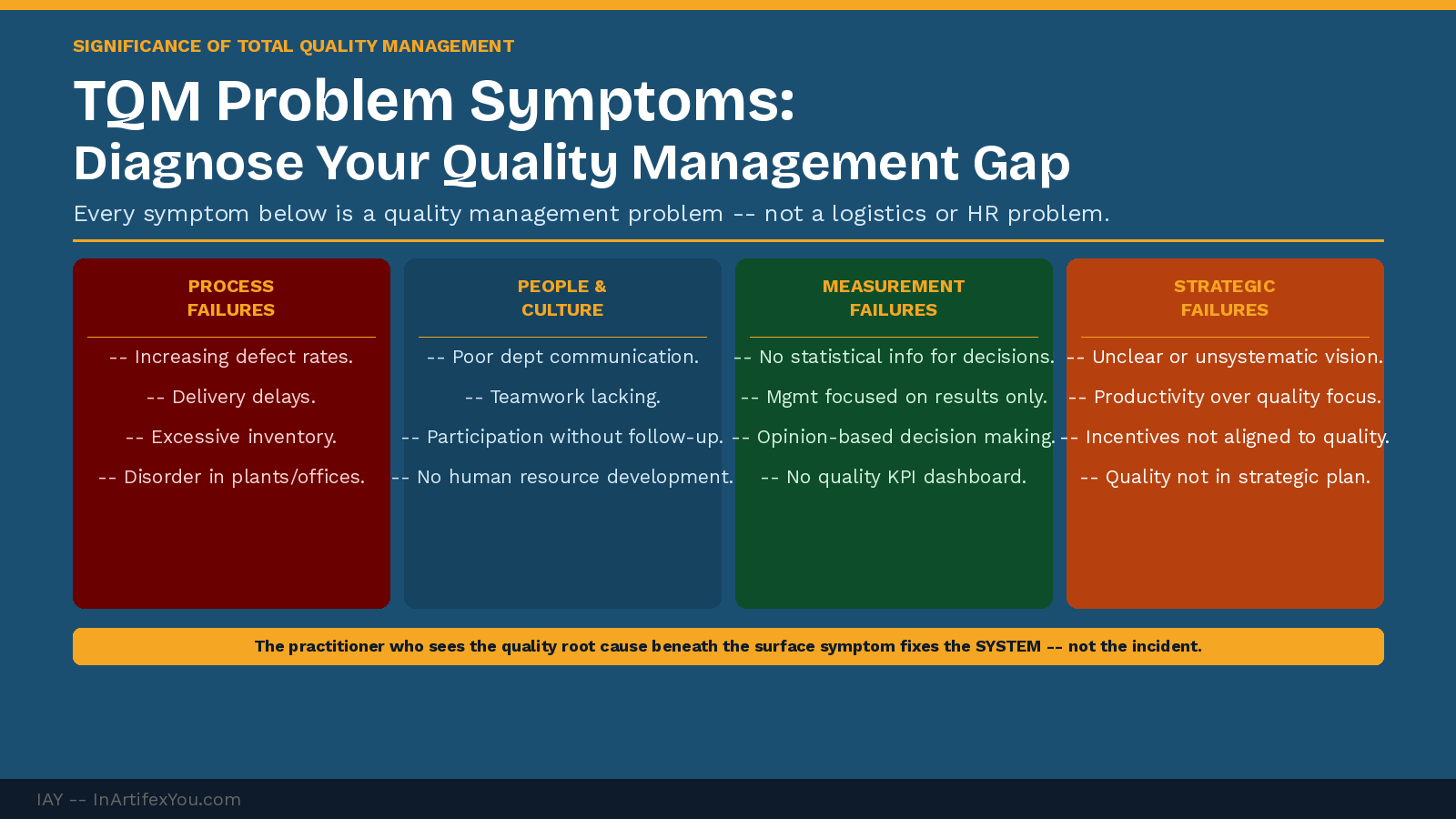
Most organizations that need TQM do not know they need it — because the symptoms of a TQM gap look like normal business problems rather than quality management failures. Delivery delays look like a logistics problem. High rework costs look like an operations problem. Poor interdepartmental communication looks like a people problem. The TQM diagnostic framework below reveals the underlying quality management gap that these symptoms share.
Symptom Category 1: Process Discipline Failures
These symptoms indicate that processes are not defined, followed, or controlled consistently:
|
Symptom |
Root Cause |
TQM Response |
|
Increasing defect rates. |
No SPC — processes adjusted based on opinion, not data. |
Implement SPC on high-defect processes. Train operators to read control charts. |
|
Delivery delays. |
Process capacity not matched to demand. |
Bottlenecks unmanaged. Apply TOC five focusing steps. Implement Drum-Buffer-Rope scheduling. |
|
Excessive inventory. |
Push production without pull signals. |
No kanban discipline. Implement pull scheduling. Set WIP limits. Apply kanban. |
|
Disorder in plants and offices. |
No 5S. No visual management. No audit discipline. |
Implement 5S. Establish visual management standards. Set audit schedule. |
Symptom Category 2: People and Culture Failures
These symptoms indicate that TQM's cultural foundation — engagement, ownership, and cross-functional collaboration — is absent:
- Poor communication between departments: silos are a cultural symptom — they indicate that functions optimize for their own metrics rather than for overall system performance. TQM response: implement cross-functional improvement teams with shared outcome metrics.
- Teamwork lacking: improvement work assigned to individuals rather than teams. TQM response: structure all improvement projects as team events — Kaizen events, quality circles, cross-functional working groups.
- Employee participation without objectives or follow-up: suggestion systems that collect ideas but never implement them destroy engagement faster than having no suggestion system at all. TQM response: implement a closed-loop suggestion system with defined response times and visible implementation tracking.
Symptom Category 3: Measurement Failures
These symptoms indicate that fact-based decision making — a core TQM principle — is not embedded:
- Lack of statistical information: decisions made on gut feel rather than process data. TQM response: establish a quality dashboard with the five essential quality KPIs — FPY, defect rate, DPMO, COPQ, and CSAT — reviewed at every management meeting.
- Management focused on results only, not process improvement: hitting the number while allowing the process to deteriorate. TQM response: add process performance metrics to every management review — not just output metrics.
Symptom Category 4: Strategic Failures
These symptoms indicate that TQM has not been integrated at the strategic level:
- Unclear or unsystematic vision: quality objectives not connected to the organization's strategic direction. TQM response: include quality performance targets in the strategic plan alongside financial targets.
- Incentive and reward systems not aligned with quality: salespeople rewarded for volume regardless of quality, production rewarded for output regardless of defect rate. TQM response: include quality metrics in every role's performance objectives and every team's incentive calculation.
The Diagnostic Principle
Every symptom on this list is a quality management problem — not a logistics, HR, or operations problem.
The practitioner who sees the quality management root cause beneath the surface symptom is the one who fixes the system — not just the incident.
Back to hub: Significance of TQM.
| ||||||||||||||||||||||
The Continuous Improvement Certification at InArtifexYou gives you a complete, practical system to map, baseline, improve, and sustain any process — and the verified credential to prove you can lead it.
inartifexyou.com/continuous-improvement-certification-online.html | ||||||||||||||||||||||
|