TQM in manufacturing: implementation priorities and
quick wins
TQM implementation in manufacturing follows four priority phases based on speed of impact and organizational readiness. Phase 1 — Stabilize: implement Statistical Process Control on the highest-defect processes to distinguish signal from noise and stop tampering with stable processes. Phase 2 — Improve: run targeted Kaizen events on the top three defect categories identified by Pareto analysis — fast, visible results that build organizational confidence in TQM. Phase 3 — Sustain: implement 5S and visual management to make abnormal conditions immediately visible, and establish standardized work to lock in improvements. Phase 4 — Extend: apply the same TQM disciplines to supplier quality and incoming materials — because 60–70% of product quality is determined before the material enters the production process. Each phase builds on the previous one — organizations that attempt Phase 3 or 4 before completing Phase 1 consistently fail to sustain their improvements.
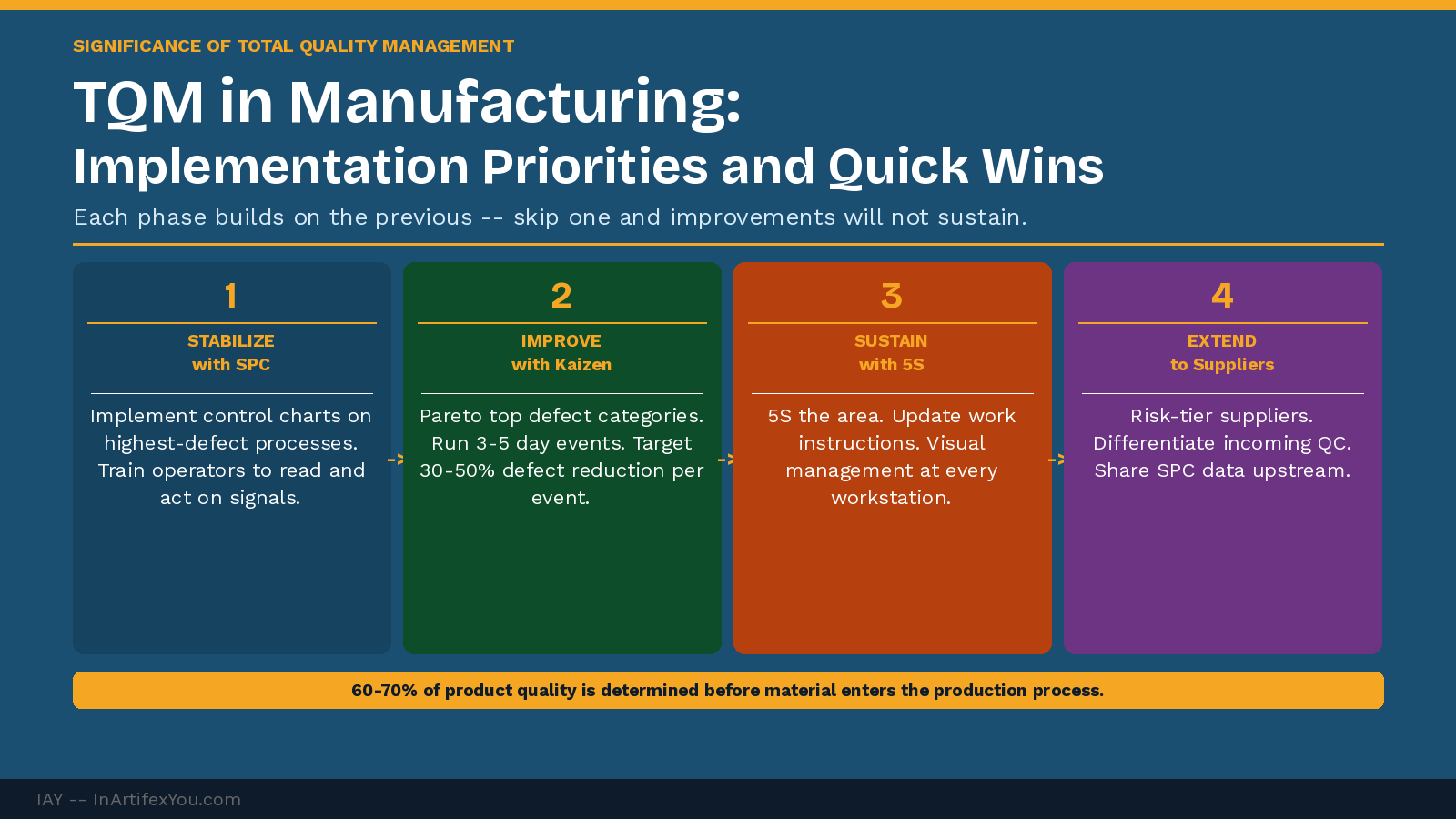
Manufacturing is where TQM produces its most visible and measurable results — because manufacturing quality failures are immediately countable: defective parts, scrap weight, rework hours, yield loss. This countability is both an advantage and a risk: it is easy to measure improvement, but it is also easy to focus on the visible costs while ignoring the systemic causes. The four-phase implementation sequence below addresses both — producing fast, measurable results while building the systemic foundation that makes those results permanent.
Phase 1: Stabilize with SPC
The first TQM priority in any manufacturing environment is to distinguish stable processes from unstable ones — and to stop making adjustments to stable processes that are actually making them less stable. Statistical Process Control (SPC) is the tool.
- Identify the five processes with the highest defect rates or yield losses — these are the first SPC implementation targets.
- Apply the appropriate control chart (X-bar R, I-MR, p-chart) for each process and establish control limits from at least 20 subgroups of production data.
- Train operators to read control charts and apply the Nelson Rules — the goal is operator-level process monitoring, not quality department monitoring.
- Identify and eliminate special causes first — before attempting any process improvement on common cause variation.
Phase 2: Improve with Kaizen
Once processes are stable and monitored, Pareto analysis of defect data identifies the 20% of defect categories responsible for 80% of the defect volume. Kaizen events target these categories:
|
Kaizen Target |
Typical Duration |
Expected Outcome |
Measurement |
|
Top defect category by volume. |
3–5 days. |
30–50% defect reduction in targeted area. |
Defect rate before vs. 30 days after event. |
|
Highest scrap cost process. |
3–5 days. |
20–40% scrap cost reduction. |
Monthly scrap cost before vs. after. |
|
Highest rework labor process. |
3–5 days. |
25–40% rework hour reduction. |
Weekly rework hours before vs. after. |
Phase 3: Sustain with 5S and Standardized Work
Improvements that are not standardized revert. Phase 3 locks in Kaizen gains by embedding the improved methods into the work standard and making the production environment self-auditing:
- 5S the production area: Sort (remove unnecessary items), Set in Order (a place for everything), Shine (clean to inspect), Standardize (visual standards for the area), Sustain (audit schedule and accountability).
- Update work instructions to reflect improved methods — the new standard is the only standard.
- Implement visual management at each workstation: current shift defect count, process status indicators, SPC chart displayed at point of work.
Phase 4: Extend to Supplier Quality
The final phase extends TQM disciplines to the supply chain — because incoming material quality is the upstream constraint on manufacturing quality. A production process cannot consistently produce conforming output from non-conforming inputs, regardless of how well the process is controlled.
- Apply the supplier risk tiering model — Tier 1 critical suppliers receive on-site quality audits and monthly DPPM reviews.
- Implement incoming quality control differentiated by supplier performance history — dock-to-stock for high performers, 100% inspection for new or at-risk suppliers.
- Share SPC data with strategic suppliers — help them achieve process stability upstream of your production line.
Back to hub: Significance of TQM.
| ||||||||||||||||||||||
The Continuous Improvement Certification at InArtifexYou gives you a complete, practical system to map, baseline, improve, and sustain any process — and the verified credential to prove you can lead it.
inartifexyou.com/continuous-improvement-certification-online.html | ||||||||||||||||||||||
|