TQM in sales and marketing: applying quality
principles to revenue functions
TQM applied to sales and marketing treats revenue functions as quality-manageable processes — with measurable inputs, defined processes, and customer-facing outputs that can be improved systematically. The four TQM applications in sales and marketing are: process standardization (defining the standard sales process and marketing workflow so that quality can be measured and improved consistently), error reduction (applying mistake-proofing to proposal generation, contract creation, and campaign execution to eliminate the errors that damage customer trust), Voice of the Customer integration (systematically feeding customer feedback from sales interactions into the product and service improvement cycle), and quality metrics for revenue functions (measuring not just revenue outcomes but the quality of the process that produces them — proposal accuracy rate, on-time delivery of marketing commitments, first-contact resolution rate for sales inquiries). TQM in sales and marketing is not about controlling salespeople — it is about making the processes they operate more reliable and more effective.
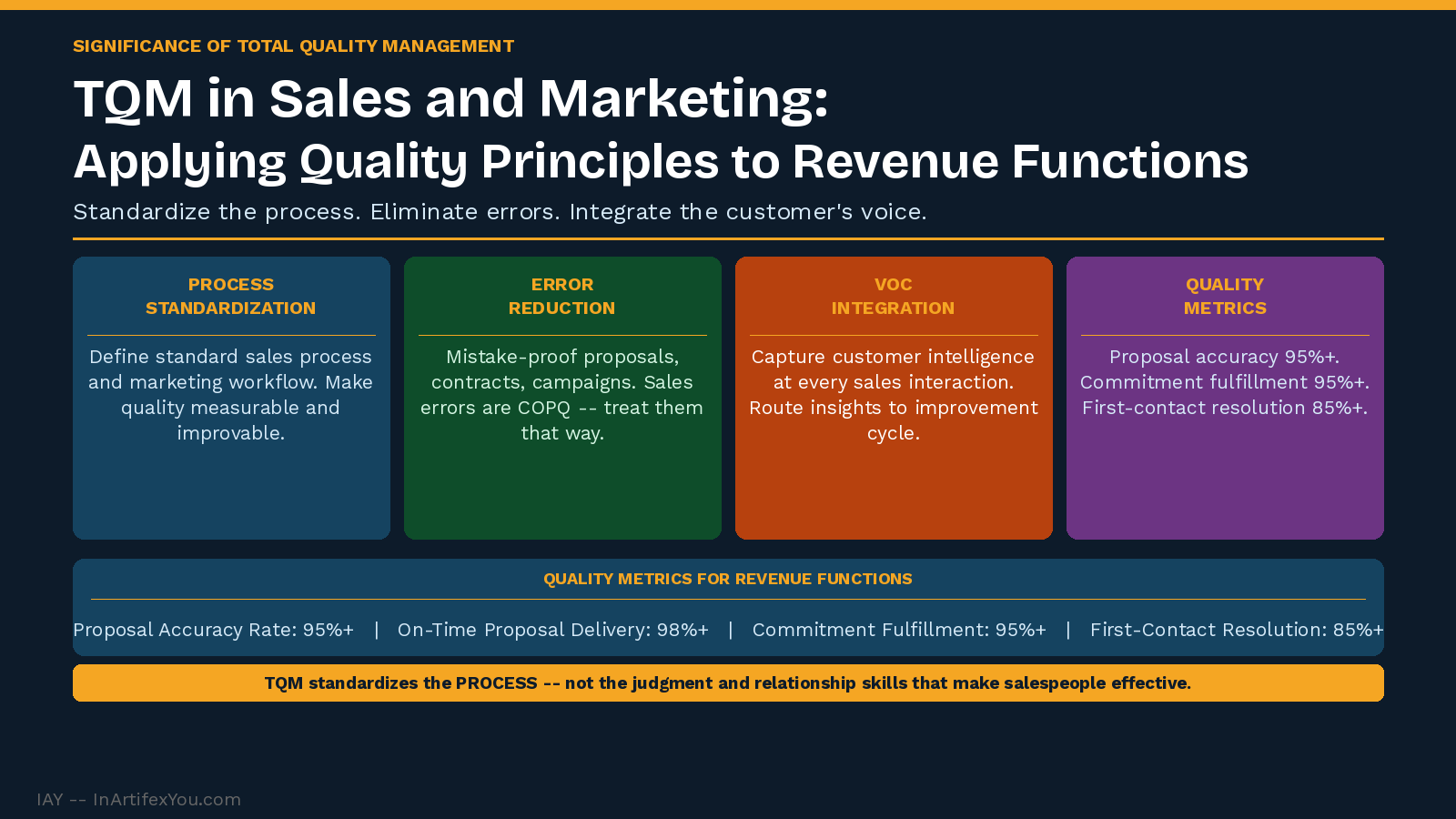
Sales and marketing teams frequently resist TQM application with one objection: 'our work is too creative and relationship-driven for process standardization.' This objection misunderstands what TQM standardizes. TQM standardizes the process — the sequence of activities, the accuracy of documents, the consistency of customer communication — not the judgment and relationship skills that make salespeople effective. A standardized sales process with built-in quality controls produces more revenue, not less, because it eliminates the errors and inconsistencies that damage customer trust and derail deals.
TQM Application 1: Process Standardization
Every repeatable sales and marketing activity is a candidate for process standardization:
- Lead qualification process: a defined set of criteria and questions that every salesperson applies consistently — prevents wasted time on unqualified opportunities and ensures that high-potential leads receive appropriate attention.
- Proposal generation: a standard proposal template with defined sections, accuracy checkpoints, and a review step before submission — eliminates the pricing errors, scope omissions, and factual inaccuracies that lose deals.
- Marketing campaign execution: a standard campaign checklist — target audience, message, channel, timeline, success metrics — applied before every campaign launch reduces the frequency of campaigns that miss objectives.
TQM Application 2: Error Reduction in Customer-Facing Processes
Errors in customer-facing processes — wrong pricing, missed commitments, inaccurate proposals — are the quality failures of the sales function. They are COPQ just as surely as scrap and rework are COPQ in manufacturing.
|
Sales/Marketing Error |
Quality Cost |
TQM Prevention Tool |
|
Incorrect pricing in proposal. |
Deal lost or margin erosion. |
Proposal review checklist + pricing approval workflow. |
|
Missed delivery commitment. |
Customer trust damage, potential churn. |
Commitment tracking system + alert at risk-of-miss threshold. |
|
Wrong product specification. |
Returns, rework, customer dissatisfaction. |
Configuration checklist + customer sign-off on specification. |
|
Campaign targeting error. |
Wasted budget, brand damage. |
Audience definition review + test before full deployment. |
TQM Application 3: Voice of the Customer Integration
The sales function is the organization's most direct channel to customer intelligence — and most organizations waste it. Salespeople hear customer objections, concerns, unmet needs, and competitive comparisons every day. TQM in sales treats this intelligence as a quality input that should feed the improvement cycle systematically:
- Capture VoC data at every sales interaction: standard fields in the CRM for customer-stated requirements, concerns, and competitive comparisons.
- Analyze VoC data monthly: which customer requirements are most commonly stated? Which competitor advantages are most frequently cited? Which product or service gaps are blocking deals?.
- Route VoC insights to the improvement cycle: the most common customer complaints become improvement project priorities — connecting sales intelligence to operational quality improvement.
TQM Application 4: Quality Metrics for Revenue Functions
- Proposal accuracy rate: percentage of proposals submitted without errors requiring revision — target above 95%.
- On-time proposal delivery: percentage of proposals delivered by committed date — target above 98%.
- Sales commitment fulfillment rate: percentage of delivery and implementation commitments met as promised — target above 95%.
- First-contact resolution for sales inquiries: percentage of customer questions answered completely on first contact — target above 85%.
Back to hub: Significance of TQM.
| ||||||||||||||||||||||
The Continuous Improvement Certification at InArtifexYou gives you a complete, practical system to map, baseline, improve, and sustain any process — and the verified credential to prove you can lead it.
inartifexyou.com/continuous-improvement-certification-online.html | ||||||||||||||||||||||
|