What Advanced
Lean Training curriculum should a mid-size manufacturer adopt?
A mid-size manufacturer — 100 to 1,000 employees — needs a Lean curriculum structured in three tiers: Foundation (all employees, 4–8 hours), Practitioner (team leaders and supervisors, 40 hours), and Expert (improvement project leads, 80–120 hours). Foundation covers the 7 wastes, 5S, and standard work — the vocabulary every employee needs to participate in improvement. Practitioner adds Value Stream Mapping, Kaizen facilitation, SMED, and basic problem-solving with A3. Expert adds Statistical Process Control, Hoshin Kanri (policy deployment), TPM, and Design of Experiments. The curriculum mistake most mid-size manufacturers make: trying to train everyone at the Practitioner level simultaneously. Start with a pilot team of 8–12 people at Practitioner level, run one Kaizen project with them, document the ROI, and use that result to fund the next cohort.
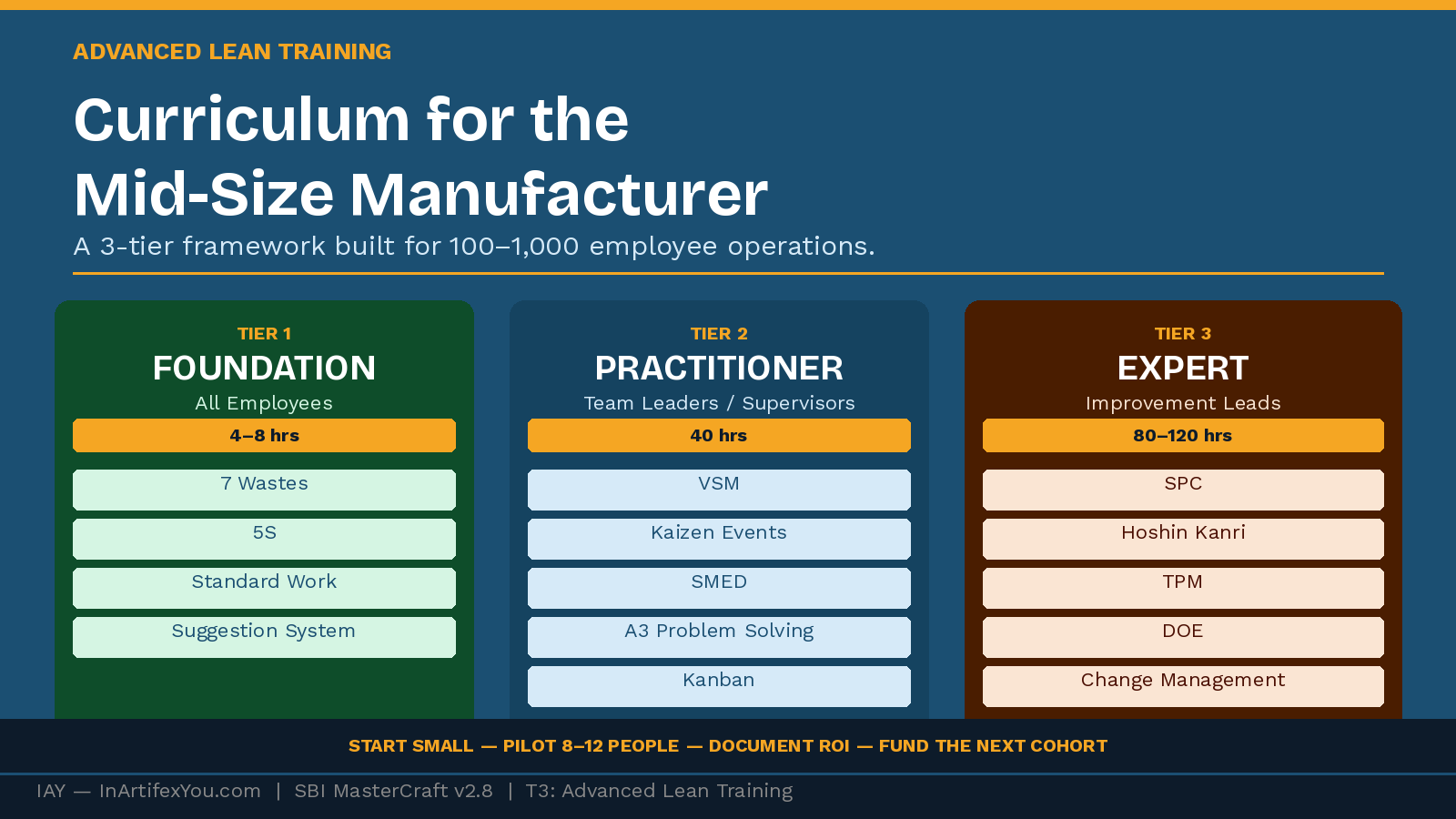
A mid-size manufacturer faces a training challenge that large corporations do not: limited budget, limited time for production employees to be off the floor, and no dedicated Lean department to drive the program. The curriculum has to be practical, sequenced, and designed to produce visible results fast enough to earn continued investment.
Here is a three-tier framework built specifically for mid-size manufacturing — and the sequencing logic that makes it work.
Tier 1 — Foundation (All Employees): 4–8 Hours
Every employee who works on or near a production process should understand the vocabulary of waste and improvement. Foundation training is not about making everyone a Lean practitioner. It is about creating a shared language that makes improvement conversations possible.
- The 7 wastes — with examples from your specific facility, not generic slides
- 5S principles — and why workplace organization directly impacts quality and safety
- Standard work — what it is, why it matters, and how to use it (not just create it)
- How to identify and report improvement opportunities — the suggestion mechanism
Deliver Tier 1 in shift-based sessions of 90 minutes. Use examples from your own floor. Generic Lean training without plant-specific context produces minimal engagement.
Tier 2 — Practitioner (Team Leaders, Supervisors): 40 Hours
Tier 2 builds the capability to lead improvement events and sustain changes. These are the people who run Kaizen events, update standard work, and maintain 5S.
- Value Stream Mapping — current state, future state, and improvement gap identification
- Kaizen event facilitation — 3–5 day rapid improvement events with PDCA discipline
- SMED — changeover reduction methodology with hands-on simulation
- A3 problem solving — structured root cause analysis and countermeasure development
- Kanban and pull system design — inventory reduction and flow control
Deliver Tier 2 in weekly sessions over 8–10 weeks, with each module followed immediately by a real application on the floor. No application = no retention.
Tier 3 — Expert (Improvement Project Leads): 80–120 Hours
Tier 3 is for the 5–10% of your workforce who will lead complex, cross-functional improvement projects and eventually coach others.
- Statistical Process Control — control charts, capability analysis, measurement system analysis.
- Hoshin Kanri / Policy Deployment — aligning improvement projects to strategic objectives.
- Total Productive Maintenance (TPM) — OEE improvement and autonomous maintenance.
- Design of Experiments (DOE) — structured experimentation for process optimization.
- Change management and coaching skills — sustaining improvement through people.
The Sequencing Rule That Mid-Size Manufacturers Miss
Critical Sequencing Principle
Do NOT train everyone at Tier 2 simultaneously.
Train a pilot group of 8–12 people at Tier 2. Run one Kaizen project with them. Document the ROI with finance sign-off. Use that documented result to fund the next cohort. Repeat.
A mid-size manufacturer that trains 8 people and achieves $200K in documented savings in 90 days will find leadership funding the next 8 immediately. One that trains 80 people with no project accountability will struggle to justify the next investment.
|
||||||||||||||||||||||
The Continuous Improvement Certification at InArtifexYou gives you a complete, practical system to map, baseline, improve, and sustain any process — and the verified credential to prove you can lead it.
inartifexyou.com/continuous-improvement-certification-online.html |
||||||||||||||||||||||
|
||||||||||||||||||||||
|
IAY — InArtifexYou.com | SBI MasterCraft v2.8 | T3: Advanced Lean Training |