Agile quality management: applying agile principles to
quality systems
Agile quality management applies the core agile principles — iterative delivery, cross-functional teams, customer focus, and rapid adaptation — to quality system design and quality improvement work. In practice it means three things. First, agile QMS design: quality management systems designed with minimal necessary documentation, living documents updated continuously rather than periodically reviewed, and quality processes embedded in work rather than layered on top of it. Second, iterative quality improvement: improvement projects run in short cycles with visible results rather than long sequential projects — a Kaizen event structure applied to quality improvement work. Third, quality in agile development teams: embedding quality verification into every sprint rather than concentrating quality review at project end. The alternative — adding a quality audit phase after agile development completes — defeats the purpose of agile by reintroducing a sequential waterfall stage at the end of an iterative process.
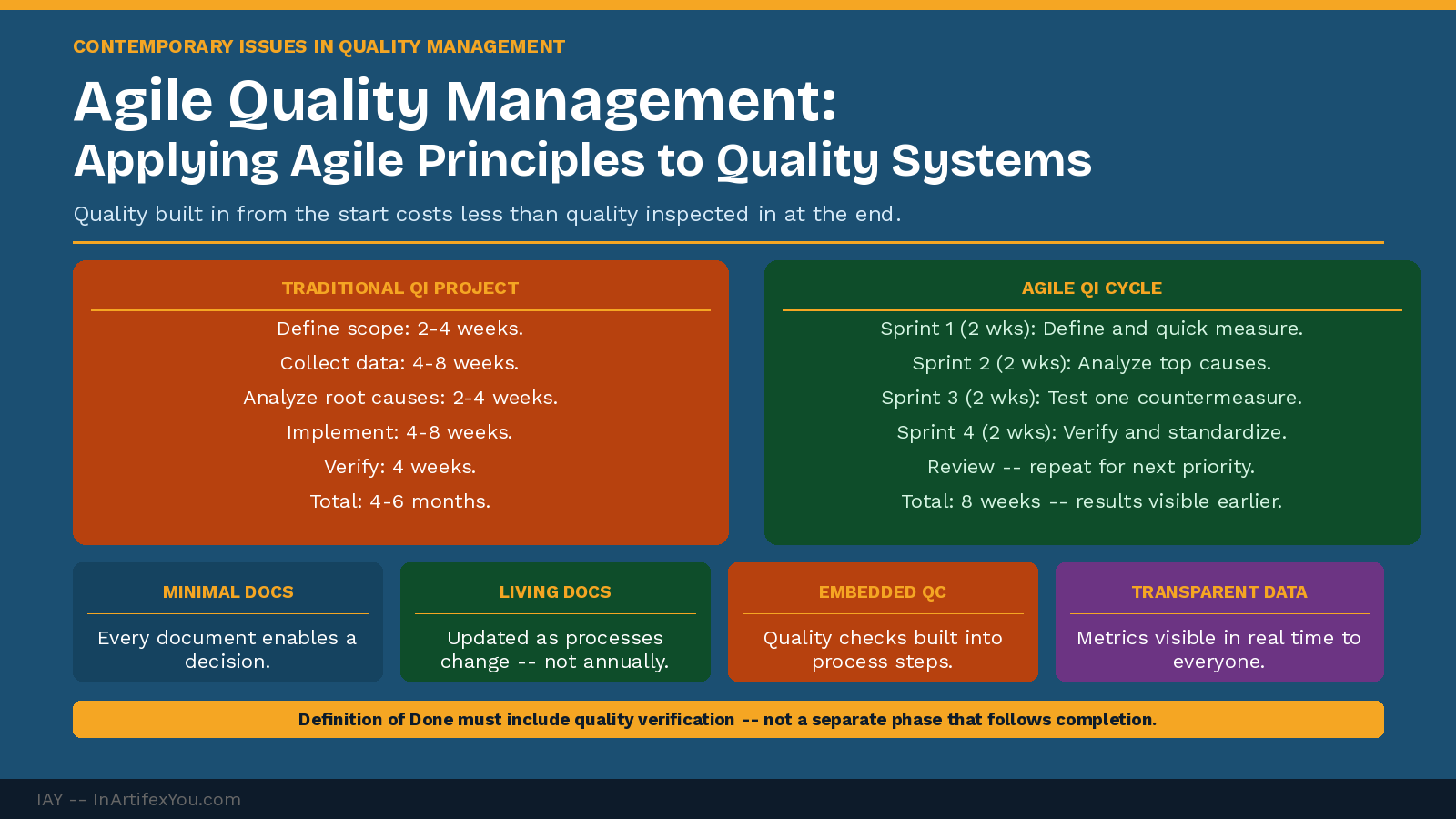
Traditional quality management systems were designed for stable, predictable environments — where processes are well-defined, specifications are fixed, and the primary quality challenge is conformance to established standards. Agile quality management addresses the contemporary reality that many organizations now operate in: fast-changing customer requirements, continuous product evolution, and improvement cycles measured in weeks rather than quarters.
Agile QMS Design Principles
- Minimal viable documentation: every quality document should answer the question 'what decision does this document enable?' — if it does not enable a decision, it does not belong in the QMS.
- Living documents: quality procedures updated as processes change — not reviewed annually and approved through a six-week change control process.
- Embedded quality: quality checks built into process steps rather than added as separate inspection stages that slow the workflow.
- Transparent quality data: quality metrics visible in real time to everyone involved in the process — not consolidated monthly into a management report.
Iterative Quality Improvement
Applying agile principles to quality improvement means replacing long sequential projects with short iterative cycles:
|
TRADITIONAL QI PROJECT Define scope: 2–4 weeks. |
AGILE QI CYCLE |
Quality Integration in Agile Development Teams
In software and product development teams using Scrum or Kanban, quality must be integrated into every sprint rather than reserved for a final testing phase:
- Definition of Done includes quality verification: every sprint's Definition of Done specifies which quality checks must pass before work is considered complete.
- Built-in testing: automated testing is part of the development sprint, not a separate QA sprint after development completes.Continuous integration: every code commit triggers automated quality checks — errors are caught within hours of introduction, not weeks later during a dedicated test phase.
- Quality retrospectives: every sprint retrospective includes a quality review — what quality issues emerged this sprint and what process change will prevent recurrence?.
The Agile Quality Principle
Quality built in from the start costs less than quality inspected in at the end.
In agile environments, this means making quality verification part of the definition of 'done' for every work item — not a phase that follows completion.PY Formulaop
| ||||||||||||||||||||||
The Continuous Improvement Certification at InArtifexYou gives you a complete, practical system to map, baseline, improve, and sustain any process — and the verified credential to prove you can lead it.
inartifexyou.com/continuous-improvement-certification-online.html | ||||||||||||||||||||||
|