Lean service tools in practice: how to apply lean to
service processes
Lean service tools apply the same waste elimination and flow optimization principles used in manufacturing — adapted for the intangible, people-intensive nature of service delivery. The five most impactful lean service tools are: Value Stream Mapping for services (mapping the end-to-end service delivery process from customer request to resolution, identifying wait times, handoffs, rework loops, and non-value-adding steps), Pull systems (triggering service work only when the next step is ready to receive it — eliminating work-in-process queues that extend lead times), Standard work (documenting the best-known sequence for each service task to reduce variation and enable consistent quality), Visual management (making service process status, queue depth, and quality indicators visible to the team in real time), and 5S for service environments (organizing the physical and digital workspace to eliminate the search time, retrieval errors, and information waste that consume service capacity).
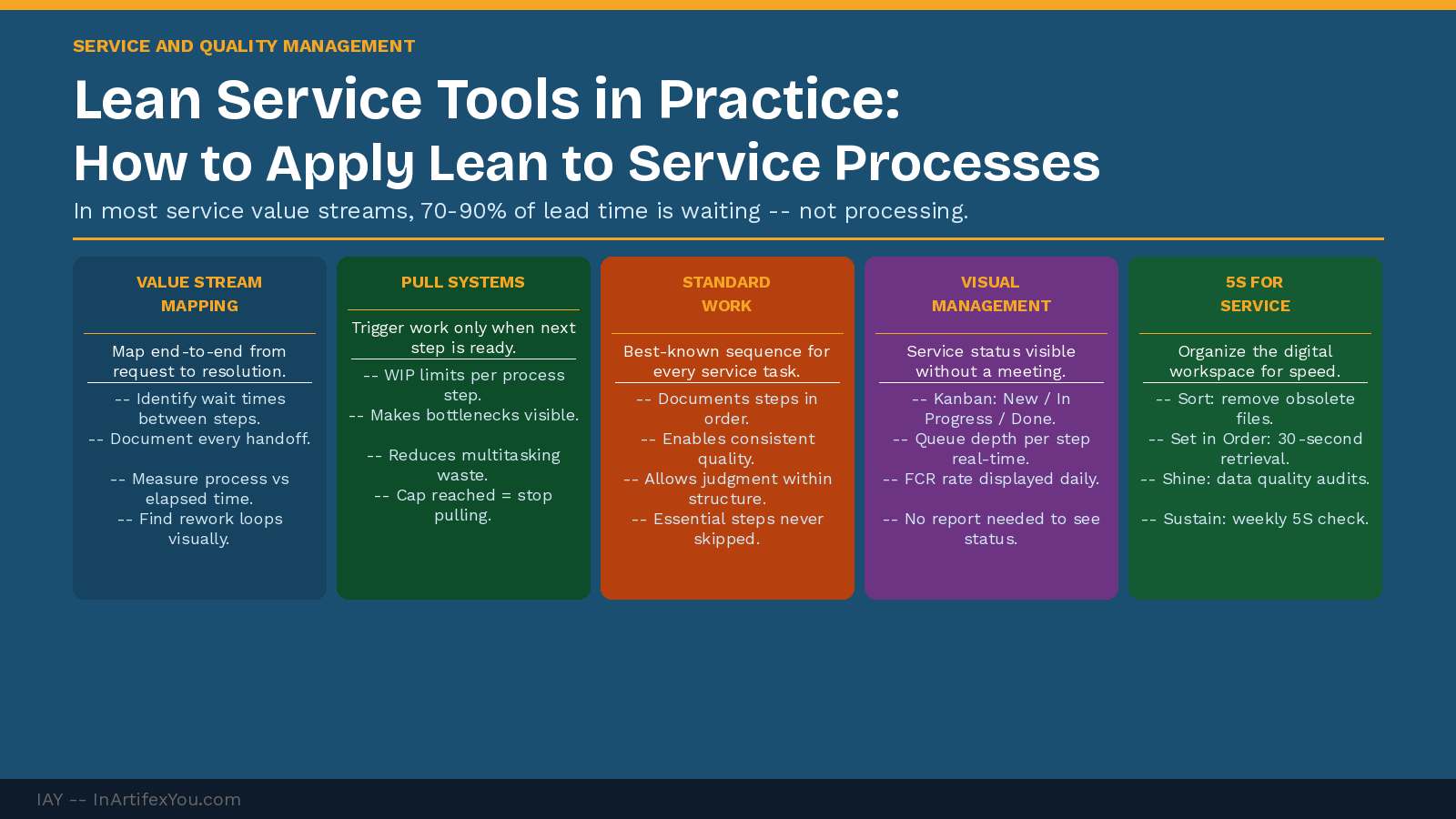
Lean service tools in practice address the same root causes as lean manufacturing tools — unnecessary waiting, excess work-in-process, rework, and non-value-adding steps — but applied to processes where the product is a transaction, a decision, an interaction, or a piece of information rather than a physical object. The adaptation required is conceptual: instead of parts waiting at a workstation, it is requests waiting in an inbox; instead of defective components, it is incorrect information or incomplete responses.
Tool 1: Value Stream Mapping for Services
A service value stream map documents every step a customer request passes through from initial contact to final resolution, including:
- Process steps: each activity performed by a team member — receiving, reviewing, processing, approving, communicating.
- Wait times: the time a request sits in a queue between process steps — typically the largest source of service lead time.
- Handoffs: every transfer of the request from one person, team, or system to another — each handoff is a delay and an error risk.
- Information flows: the data and documents that accompany the request — missing or incorrect information triggers rework loops.
The Service VSM Finding
In most service value streams, 70–90% of total lead time is waiting — not processing.
The process steps themselves are fast. The queues between them are not. Lean service improvement focuses on eliminating queue time, not speeding up processing.
Tool 2: Pull Systems for Service
A pull system in service means work is pulled to the next step only when that step has capacity — rather than being pushed as soon as it is ready. The most common service pull mechanism is a Work-In-Process (WIP) limit: each step in the service process is capped at a defined number of simultaneous items. When the cap is reached, no new work enters until an item is completed.
- WIP limits force bottleneck visibility: when a step hits its WIP limit, the constraint is visible — not hidden in a growing queue.
- WIP limits reduce multitasking: team members finish items rather than starting new ones, which reduces context-switching waste and improves throughput.
Tool 3: Standard Work for Service
Standard work in service documents the best-known sequence for executing a service task — the specific steps, in the specific order, that consistently produce the correct output with the least rework. Standard work is not a script — it is a documented process that experienced practitioners can execute with judgment while ensuring the essential steps are never skipped.
Tool 4: Visual Management for Service
Visual management in service makes the current state of the service process visible without requiring a meeting or a report:
- Kanban boards showing request status: New, In Progress, Waiting for Information, Complete.
- Queue depth indicators: number of items waiting at each process step — updated in real time.
- First-contact resolution rate displayed at team level — updated daily.
Tool 5: 5S for Service Environments3x
|
5S Step |
Service Application |
Example |
|
Sort. |
Remove unnecessary information, files, templates, and tools from the digital workspace. |
Archive completed cases. Delete obsolete templates. Remove unused shared drive folders. |
|
Set in Order. |
Organize files and information so anything needed can be found in under 30 seconds. |
Standardized folder structure. Naming conventions. Shared template library. |
|
Shine. |
Regular review of shared drives, email folders, and CRM records for accuracy and currency. |
Weekly CRM data quality check. Monthly shared drive audit. |
|
Standardize. |
Visual standards for workspace organization that apply to everyone. |
Standard folder structure enforced. Standard email signature. Standard case naming. |
|
Sustain. |
Audit schedule and accountability for maintaining the standard. |
Weekly team 5S audit. 5S score on team dashboard. |
Back to hub: Service and Quality Management.
| ||||||||||||||||||||||
The Continuous Improvement Certification at InArtifexYou gives you a complete, practical system to map, baseline, improve, and sustain any process — and the verified credential to prove you can lead it.
inartifexyou.com/continuous-improvement-certification-online.html | ||||||||||||||||||||||
|