Service waste identification: the 8 wastes in service
environments
The 8 wastes in service environments parallel the 8 wastes in manufacturing but manifest differently because service products are transactions, information, and interactions rather than physical goods. Overproduction in service: generating reports, documents, or communications that no one uses or requests. Waiting: customers or team members waiting for approvals, information, or system responses. Transportation: unnecessary handoffs between people, teams, or systems that add no value. Overprocessing: performing more steps, reviews, or approvals than the customer or the quality standard requires. Inventory: backlogs of unprocessed requests, pending approvals, or incomplete cases. Motion: unnecessary navigation between systems, physical movement between workstations, or searching for information. Defects: errors, rework, complaints, and corrections that consume capacity without creating value. Non-utilized talent: team members performing work below their skill level or not contributing improvement ideas. The most impactful wastes in most service environments are Waiting, Defects, and Non-utilized talent — together they account for the majority of service cost and quality failures.
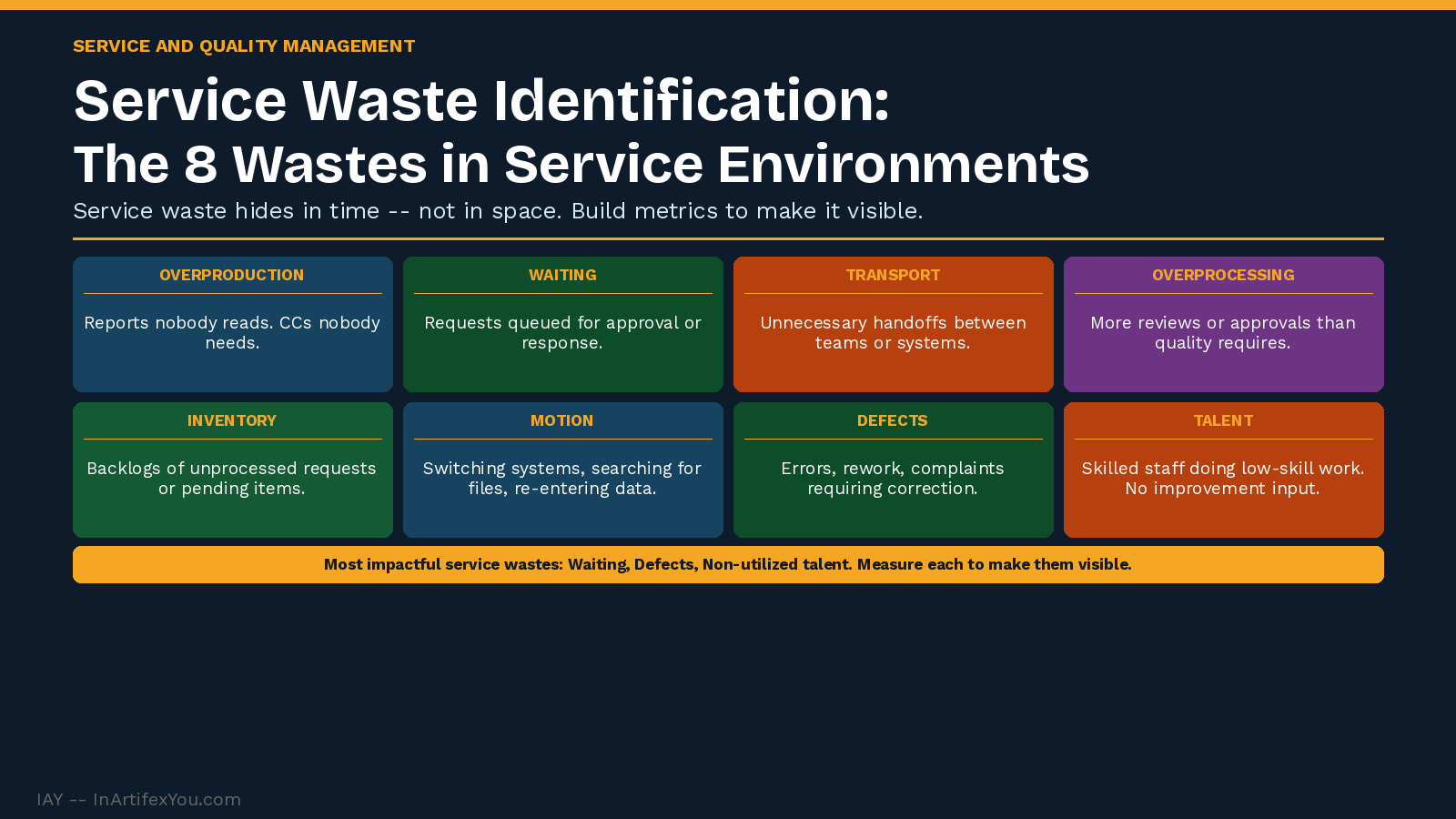
Service waste identification is the first step in any lean service improvement — because you cannot eliminate waste you cannot see. The challenge in service environments is that waste is often invisible: a request sitting in an inbox looks the same whether it has been waiting 5 minutes or 5 days. The 8 waste framework below makes service waste visible by giving teams a shared vocabulary for recognizing and naming it.
The 8 Wastes — Service Environment Mapping
|
Waste |
Service Example |
Recognition Signal |
Elimination Approach |
|
Overproduction. |
Generating weekly reports nobody reads. Sending CC emails for information coverage. |
Reports nobody responds to. Meetings that produce no decisions. |
Ask: who uses this output and what do they do with it? Stop producing what nobody acts on. |
|
Waiting. |
Requests queued waiting for approval. Customer on hold. System loading times. |
Growing inbox backlogs. Long average handle times. |
Customer complaints about response time. Map queue times in VSM. Implement WIP limits. Pre-authorize standard approvals. |
|
Transportation. |
Handoffs between departments. Forwarding emails. Re-entering data across systems. |
Number of handoffs per request. Data re-entry frequency. Email chain length. |
Reduce handoffs. Integrate systems. Cross-train for single-touch resolution. |
|
Overprocessing. |
Triple-checking work already verified. Redundant approvals. Over-elaborate responses. |
Steps that add time but no customer value. Approval chains longer than necessary. |
Map what the customer actually values. Remove steps that don't contribute to that standard. |
|
Inventory. |
Unprocessed request backlog. Pending approval queue. Draft documents never finalized. |
Aging reports. Cases open over defined SLA. Approval queue depth trend. |
WIP limits. FIFO processing. Escalation triggers for aged items. |
|
Motion. |
Switching between multiple systems. Walking to printer. Searching for files. |
Time spent navigating rather than processing. Frequent system switches per task. |
Single-screen workflows. 5S digital workspace. Co-locate frequently used tools. |
|
Defects. |
Incorrect information provided. Rework from unclear requests. Customer complaints. |
First-contact resolution rate below 85%. Rework hours. Complaint volume by category. |
Root cause analysis on defect categories. Standard work to prevent recurrence. |
|
Non-utilized talent. |
Skilled staff doing data entry. No improvement suggestion system. No cross-training. |
Employee engagement scores. Suggestion system participation rate. Skill utilization assessment. |
Quality circles. Cross-training program. Improvement suggestion system with closed-loop response. |
The Waste Identification Principle
In service environments, waste hides in time — not in space.
A manufacturing defect sits on the floor and is visible. A service defect sits in an inbox, a queue, or a customer's experience — and is invisible unless measured.
The lean service practitioner who builds measurement systems for each waste category makes the invisible visible — and gives the team a target to improve.
Back to hub: Service and Quality Management.
| ||||||||||||||||||||||
The Continuous Improvement Certification at InArtifexYou gives you a complete, practical system to map, baseline, improve, and sustain any process — and the verified credential to prove you can lead it.
inartifexyou.com/continuous-improvement-certification-online.html | ||||||||||||||||||||||
|