Service process mapping: how to visualize and improve
service flows
Service process mapping creates a visual representation of every step in a service delivery process — who does what, in what sequence, with what handoffs and decision points. The most useful format for service process mapping is the swimlane diagram: a flowchart where each horizontal lane represents a role, team, or system. Steps appear in the lane of the person or system responsible for them. Handoffs are visible as arrows crossing between lanes. The swimlane map reveals four types of improvement opportunity: unnecessary handoffs (arrows crossing between lanes that could be eliminated by cross-training or system integration), decision bottlenecks (decision diamonds where one person must approve before work continues — often the longest wait in the process), rework loops (arrows pointing backward in the flow — indicating defects that require work to be repeated), and non-value-adding steps (steps that exist for internal reasons but add no value from the customer's perspective).
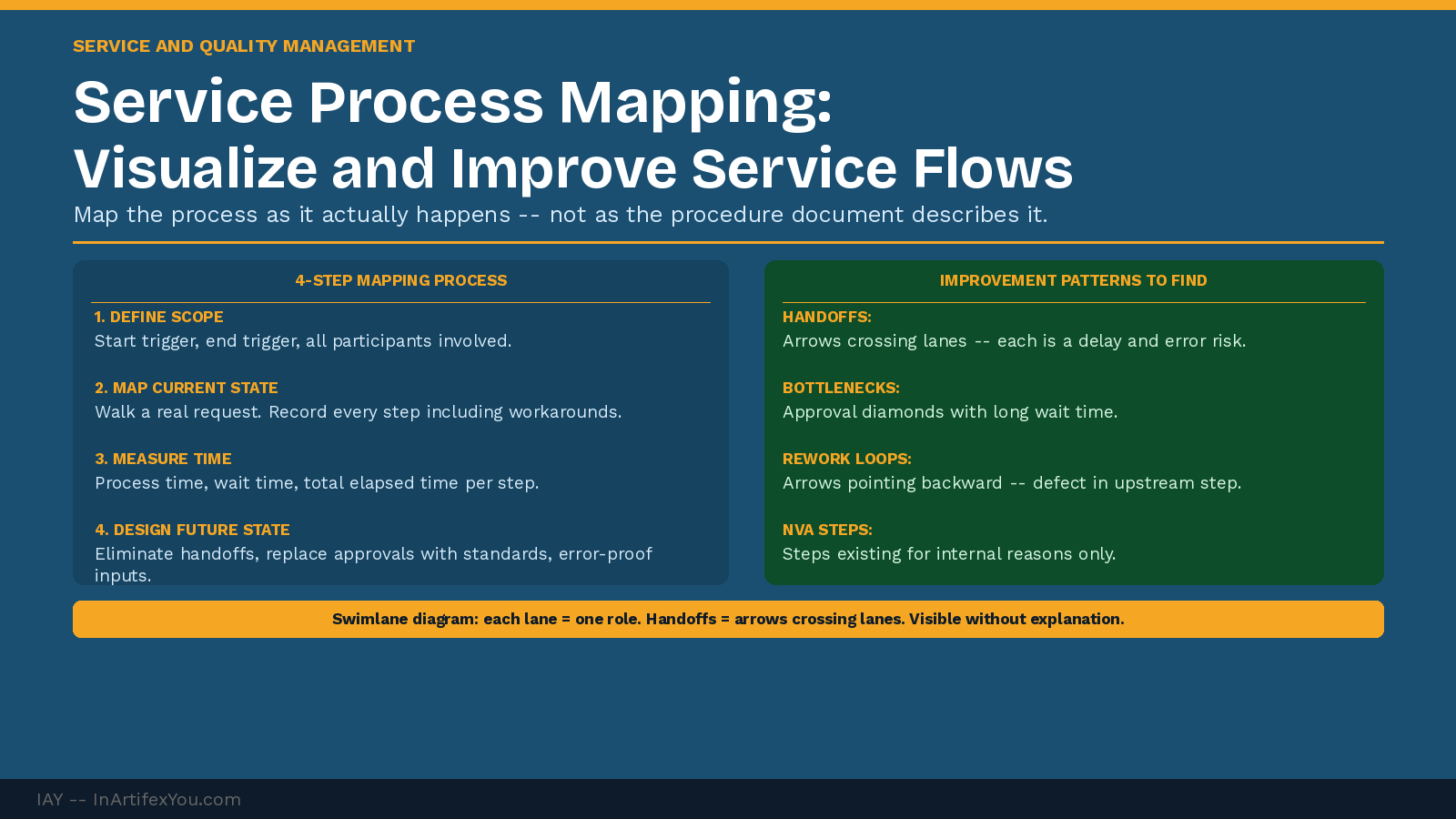
Service process mapping makes the invisible visible — it converts a mental model of how service is delivered into a shared, visual representation that a team can analyze, challenge, and improve together. Most service processes have never been formally documented: team members have individual understandings of the process that differ in important ways, and those differences are the source of inconsistency, rework, and customer complaints. The map creates a common reference point for improvement.
Step 1: Define the Scope and Boundaries
- Start trigger: what event initiates this process? A customer contact, a submitted request, a scheduled event.
- End trigger: what condition indicates the process is complete from the customer's perspective? Not internal completion — customer-perceived completion.
- Participants: which roles, teams, and systems are involved in delivering the service from start to end.
Step 2: Map the Current State
Map the process as it actually happens — not as it is supposed to happen or as the procedure document describes it. The most accurate mapping method is observation combined with structured interviews with the people who actually do the work:
- Walk the process: follow a real request through every step from trigger to completion — observing actual work, not described work.
- Record every step: include steps that seem obvious, informal, or irregular — workarounds and informal steps often reveal the most improvement opportunities.
- Measure time at each step: process time (active work), wait time (sitting in a queue), and total elapsed time from step entry to step exit.
- Document decision points: every point where a judgment or approval is required — who decides, based on what criteria, and how long it typically takes.
Step 3: Identify Improvement Opportunities
|
Pattern in the Map |
What It Reveals |
Improvement Action |
|
Multiple arrows crossing between lanes. |
Unnecessary handoffs — each is a delay and error risk. |
Cross-train for single-touch processing. Integrate systems to eliminate transfers. |
|
Diamond (decision) with long wait time. |
Approval bottleneck — one person is holding up the flow. |
Pre-authorize standard decisions. Delegate approval authority. Set SLA on decision response. |
|
Arrow pointing backward (rework loop). |
Defect in upstream step requiring correction. |
Root cause analysis on rework trigger. Standard work to prevent recurrence. |
|
Step with no customer value. |
Non-value-adding activity consuming capacity. |
Challenge the step: who requires it and why? Eliminate if answer is 'internal only.'. |
Step 4: Design the Future State
The future state map removes or reduces the improvement opportunities identified in Step 3:
- Eliminate handoffs: redesign so a single role handles as many consecutive steps as possible — increasing first-contact resolution and reducing queue time.
- Replace approvals with standards: document the criteria for routine decisions so they can be made without escalation — reserving approval authority for exceptions only.
- Error-proof upstream steps: add verification checkpoints at the point where incomplete or incorrect information enters the process — before it causes a rework loop downstream.
Back to hub: Service and Quality Management.
| ||||||||||||||||||||||
The Continuous Improvement Certification at InArtifexYou gives you a complete, practical system to map, baseline, improve, and sustain any process — and the verified credential to prove you can lead it.
inartifexyou.com/continuous-improvement-certification-online.html | ||||||||||||||||||||||
|