Service quality KPIs: which metrics reveal where
service breaks down
The five service quality KPIs that most reliably reveal where service delivery breaks down are: First Contact Resolution (FCR) — the percentage of customer issues resolved without requiring follow-up contact, strongly correlated with customer satisfaction and the single best indicator of service quality; Average Handle Time (AHT) — the average time spent on a service interaction from start to finish, a measure of process efficiency that must be balanced against quality; Customer Effort Score (CES) — how easy it was for the customer to get their issue resolved, the metric most strongly correlated with customer loyalty in service environments; SLA Compliance Rate — the percentage of service interactions meeting defined response and resolution time commitments, the reliability metric; and Quality Error Rate — the percentage of service interactions containing a factual error, procedural omission, or compliance failure, identified through quality monitoring. Each metric points to a different process failure — the practitioner who tracks all five can diagnose service quality problems with precision rather than relying on overall satisfaction scores that mask specific breakdowns.
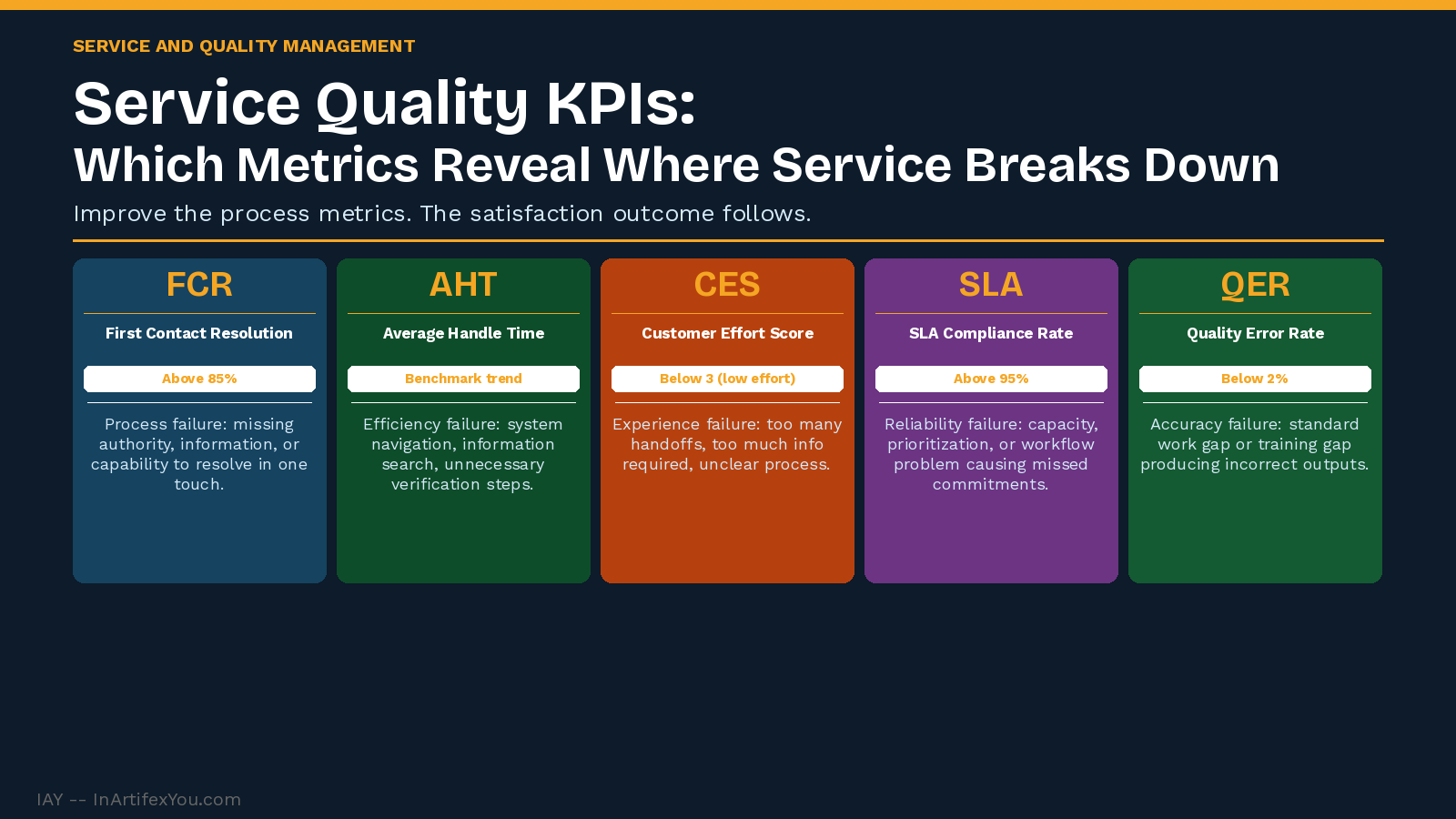
Service quality KPIs are only useful when they are connected to specific improvement actions — not when they are reported for reporting's sake. The five metrics below each reveal a different type of service process failure, point to a different root cause, and require a different improvement response. Tracking all five simultaneously gives a complete diagnostic picture of service quality performance that no single metric can provide.
The Five Service Quality KPIs
|
KPI |
Formula |
World-Class Target |
What It Reveals When Below Target |
|
First Contact Resolution (FCR). |
(Contacts resolved on first touch / Total contacts) x 100. |
Above 85%. |
Process failure: the service process cannot resolve the issue in one interaction — missing information, authority, or capability. |
|
Average Handle Time (AHT). |
Total handle time / Total contacts handled. |
Varies by service type — benchmark against own historical trend. |
Efficiency failure: process waste — unnecessary steps, system navigation, or information search consuming handle time. |
|
Customer Effort Score (CES). |
Average score on 'How easy was it?' question (1-7 scale). |
Below 3 (low effort). |
Experience failure: the customer is working too hard to get resolution — too many handoffs, too much information required, unclear process. |
|
SLA Compliance Rate. |
(Interactions meeting SLA / Total interactions) x 100. |
Above 95%. |
Reliability failure: the service process cannot consistently deliver within committed timeframes — capacity, prioritization, or workflow problem. |
|
Quality Error Rate. |
(Interactions with quality errors / Total interactions monitored) x 100. |
Below 2%. |
Accuracy failure: the service process is producing incorrect or incomplete outputs — standard work gap or training gap. |
Connecting KPIs to Improvement Actions
- Low FCR: root cause is usually one of three things — staff lack the authority to resolve (empowerment gap), staff lack the information to resolve (knowledge gap), or the request requires multiple steps the customer doesn't anticipate (process design gap). Each requires a different fix.
- High AHT: run a time study on a sample of interactions — identify where time is being spent. System navigation waste, information search waste, and unnecessary verification steps are the most common causes.
- High CES: map the customer journey for the interaction — identify the points where the customer must provide the same information twice, wait without knowing status, or navigate multiple contacts to reach resolution.
- Low SLA compliance: analyze interactions that missed SLA by stage — where in the process did the time go? Distinguish between volume overload (capacity problem) and individual interaction time (process efficiency problem).
- High error rate: quality monitoring sample analysis — which error types appear most frequently, in which process step, and under which conditions? Standard work or training gap per error category.
he KPI Principle
Overall customer satisfaction scores are outcomes — they tell you the result but not the cause.
FCR, AHT, CES, SLA compliance, and error rate are process metrics — they tell you where in the service process the failure occurred.
Improve the process metrics and the satisfaction outcome follows.
Back to hub: Service and Quality Management.
| ||||||||||||||||||||||
The Continuous Improvement Certification at InArtifexYou gives you a complete, practical system to map, baseline, improve, and sustain any process — and the verified credential to prove you can lead it.
inartifexyou.com/continuous-improvement-certification-online.html | ||||||||||||||||||||||
|