SERVQUAL in practice: how to measure and close service
quality gaps
SERVQUAL measures service quality by calculating the gap between customer expectations and customer perceptions across five service quality dimensions: Reliability (ability to deliver the promised service accurately and dependably — the most important dimension), Responsiveness (willingness to help customers and provide prompt service), Assurance (knowledge and courtesy of staff and their ability to inspire trust), Empathy (caring, individualized attention provided to customers), and Tangibles (physical facilities, digital interfaces, and staff appearance). The gap score for each dimension is calculated as: Perception score minus Expectation score. A negative gap — where expectations exceed perceptions — indicates a quality failure on that dimension. The dimension with the largest negative gap is the highest-priority improvement target. SERVQUAL's practical value is in directing improvement investment: it prevents organizations from improving Tangibles (the lowest-impact dimension) while ignoring Reliability failures (the highest-impact dimension).
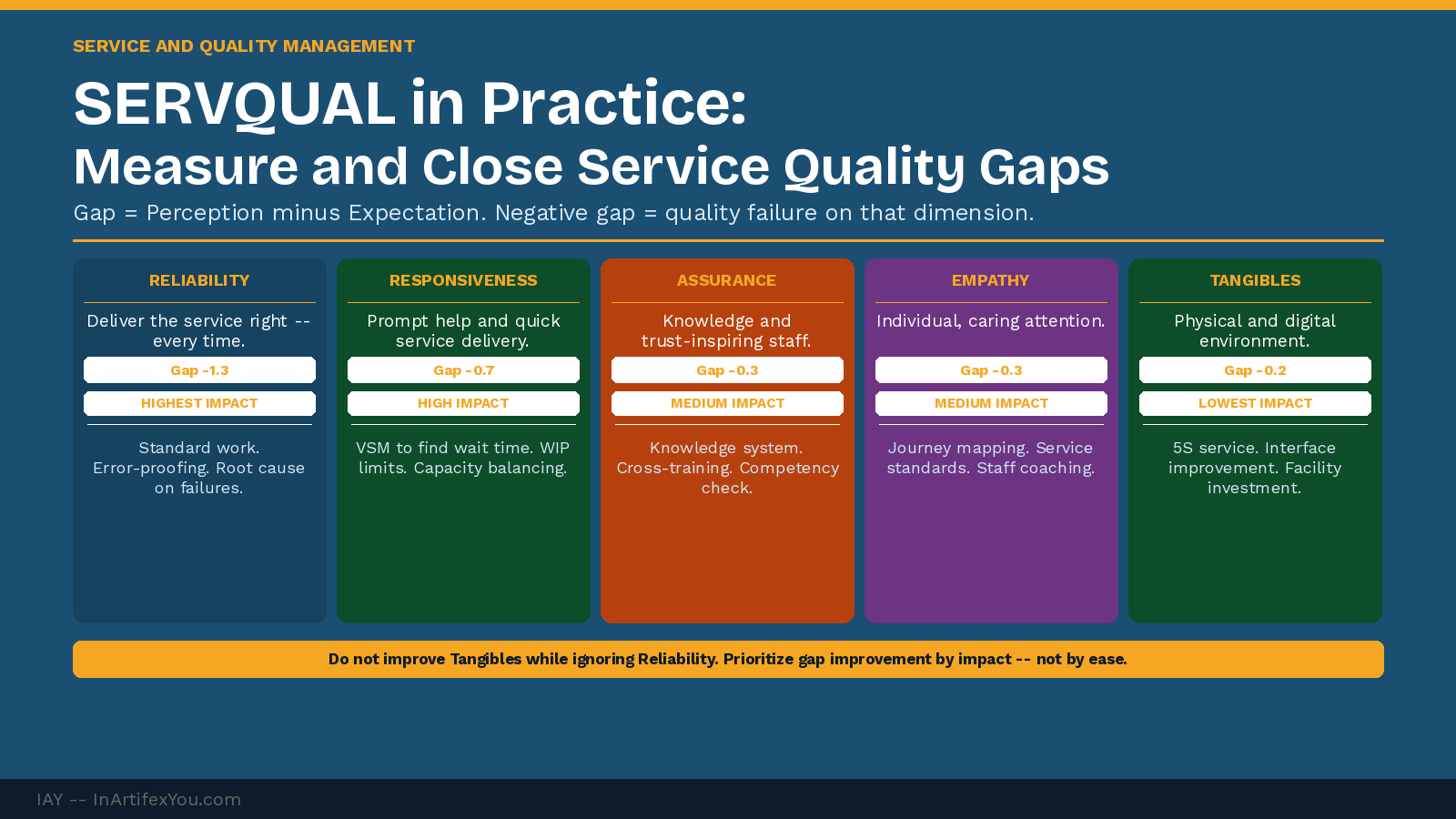
SERVQUAL in practice requires moving beyond the survey itself to the improvement actions the gaps identify. Many organizations run SERVQUAL surveys, calculate gap scores, and then do nothing specific with the results — because they do not connect each gap to a specific process failure and a targeted improvement action. The framework below converts SERVQUAL findings into an actionable improvement agenda.
Step 1: Survey Design
A SERVQUAL survey measures both expectations and perceptions for a set of statements covering all five dimensions. For each statement, respondents rate:
- Expectation (E): what level of service they expect from an excellent service provider in this category (1–7 scale).
- Perception (P): what level of service this organization actually delivered (1–7 scale).
- Gap score: P minus E. Negative values indicate a quality failure on that attribute.
Step 2: Calculate and Prioritize Gaps
|
Dimension |
Example Statement |
Typical Expectation |
Typical Perception |
Gap |
Priority |
|
Reliability. |
They deliver the service right the first time, every time. |
6.4 |
5.1 |
-1.3 |
1 — Highest impact. |
|
Responsiveness. |
Staff respond quickly to my requests. |
6.1 |
5.4 |
-0.7 |
3. |
|
Assurance. |
Staff have the knowledge to answer my questions. |
5.9 |
5.6 |
-0.3 |
4. |
|
Empathy. |
Staff give me individual attention. |
5.5 |
5.2 |
-0.3 |
4 |
|
Tangibles. |
The physical environment looks professional. |
5.2 |
5.0 |
-0.2 |
5 — Lowest impact. |
Step 3: Connect Gaps to Process Failures
Each SERVQUAL dimension gap points to a specific type of process failure:
|
DIMENSION GAP |
PROCESS FAILURE |
IMPROVEMENT DIRECTION |
|
Reliability gap. |
Inconsistent service outcomes from same input. |
Standard work, error-proofing, root cause analysis. |
|
Responsiveness gap. |
Queue times exceed customer expectations. |
VSM to identify wait time, WIP limits, capacity balance. |
|
Assurance gap. |
Staff knowledge insufficient to resolve or reassure. |
Knowledge management, cross-training, competency assessment. |
|
Empathy gap. |
Service feels impersonal -- task focus over customer focus. |
Customer journey mapping, service standards, staff coaching. |
|
Tangibles gap. |
Physical or digital environment below expectation. |
5S for service environment, digital interface improvement. |
|
Gap |
Process Failure |
Improvement Direction |
|
Reliability gap. |
Service process inconsistent — different outcomes from the same input. |
Standard work. Error-proofing. Root cause analysis on failure modes. |
|
Responsiveness gap. |
Service process too slow — queue times exceed customer expectations. |
VSM to identify wait time. WIP limits. Capacity balancing. |
|
Assurance gap. |
Staff knowledge insufficient — unable to resolve or inspire confidence. |
Knowledge management system. Cross-training. Competency assessment. |
|
Empathy gap. |
Service feels impersonal — staff focus on task completion, not customer experience. |
Customer journey mapping. Service standard for personalization. Staff coaching. |
|
Tangibles gap. |
Physical or digital environment below expectation. |
5S for service environment. Digital interface improvement. Facility investment. |
The SERVQUAL Application Principle
Do not improve Tangibles while ignoring Reliability.
Tangibles are the easiest dimension to improve and the lowest-impact dimension for customer loyalty. Reliability is the hardest to improve and the highest-impact dimension.
Prioritize gap improvement by impact, not by ease.
Back to hub: Service and Quality Management.
| ||||||||||||||||||||||
The Continuous Improvement Certification at InArtifexYou gives you a complete, practical system to map, baseline, improve, and sustain any process — and the verified credential to prove you can lead it.
inartifexyou.com/continuous-improvement-certification-online.html | ||||||||||||||||||||||
|